
Quick Answer
Traditional external wall insulation delivers the greater reduction in heat loss, because it adds a substantial thickness of insulation board to the wall. Spray cork adds a thin, breathable, flexible coating that improves surface performance, bridges cracks and weatherproofs the wall without changing its thickness or appearance in the way render does. Choose board-based EWI where maximum thermal improvement is the priority and the added thickness is acceptable. Choose spray cork where breathability, appearance, detailing, cost or disruption matter, or where thickness cannot be added.
What Is Traditional External Wall Insulation?
Board-based EWI involves mechanically fixing and bonding insulation boards, usually EPS or mineral wool, to the outside face of the wall. A reinforced basecoat and mesh go over the top, followed by a render or brick-effect finish.
The result is a thick insulating layer wrapped around the building. On a solid wall property with no cavity, this can produce a substantial reduction in heat loss, and it is the option normally specified when the aim is to hit a particular U-value target under a funded scheme or a retrofit standard.
It is a significant piece of work. The wall gains around 100mm or more in thickness, which affects window reveals, door thresholds, eaves, downpipes and boundaries. It is not a quick job and it is not a cheap one.
What Is Spray Cork?
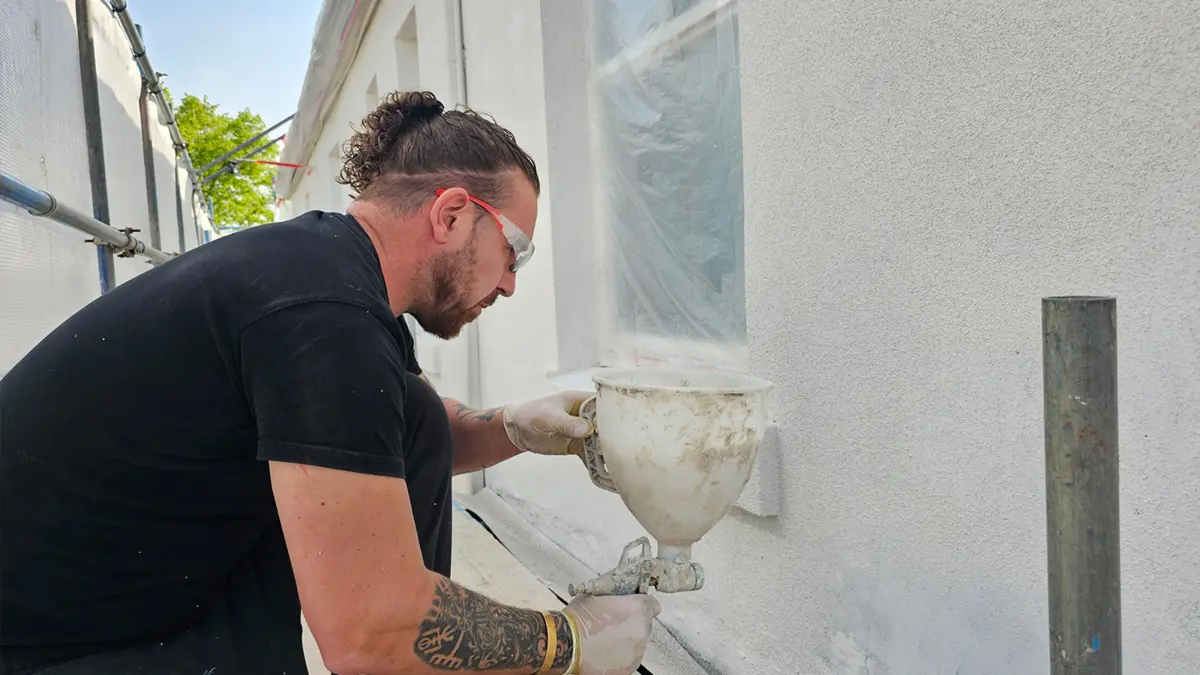
Spray cork is a coating made from natural cork granules and resins, applied directly to the existing wall surface with spray equipment.
It goes on as a seamless, flexible layer that follows the shape of what is beneath it. Because it is a coating rather than a board system, it adds only millimetres rather than centimetres. That means reveals, eaves and boundary clearances stay as they are.
ReveCork is breathable, which allows moisture to leave the wall rather than being trapped behind an impermeable layer. It is also flexible, so it bridges existing hairline cracks and accommodates the movement that causes render to crack in the first place.
Which Performs Better Thermally?
This is the question that matters most, and it deserves a straight answer rather than a sales pitch.
Board-based EWI delivers the larger reduction in heat loss. Adding 90 to 100mm of insulation to a solid wall transforms its thermal performance in a way that no thin coating can match. If your objective is the biggest possible improvement to a U-value, and you can accept the thickness, cost and disruption, that is the honest recommendation.
Spray cork contributes thermally in a different way. It improves the performance of the wall surface, helps reduce the effects of thermal bridging and raises internal surface temperatures, which is what actually stops condensation forming and mould growing. Many homeowners notice rooms that feel warmer and less draughty. What it does not do is replicate 100mm of insulation board, and anyone claiming otherwise is overselling it.
The useful question is therefore not which insulates more, but whether the additional thermal gain from board-based EWI justifies its cost, thickness and disruption on your particular property.
Where Spray Cork Has The Advantage
There are several situations where spray cork is the better choice regardless of raw thermal numbers.
Where thickness cannot be added. Properties on tight boundaries, close to a pavement, with shallow eaves overhangs or with limited window reveal depth often cannot take 100mm of board without significant alteration work.
Where appearance matters. Board EWI covers detail. Spray cork follows the existing surface, so quoins, mouldings, string courses and textured finishes remain visible rather than being buried under render.
Where the wall needs to breathe. Older solid wall properties were built to allow moisture to move through the fabric. Wrapping them in an impermeable layer can cause problems. A breathable coating works with that construction rather than against it.
Where render keeps cracking. Rigid render cracks because it cannot accommodate movement. A flexible coating bridges hairline cracks and is far less likely to fail in the same way.
Where cost and disruption are the constraint. Spray cork is applied far more quickly, with less scaffolding time, less mess and considerably less alteration to the building than a full EWI system.
Where Traditional EWI Has The Advantage
Being fair about this matters, because the wrong recommendation costs a homeowner money.
Board-based EWI is the better option where the primary objective is maximum heat loss reduction on a solid wall property with high heating bills, where a specific U-value must be achieved for a grant scheme or retrofit standard, or where the wall is in poor enough condition that it needs building up rather than coating.
It is also worth noting that funded schemes generally specify board-based systems, so if you are pursuing grant support, that may make the decision for you.
Can You Use Both?
Yes, and on some properties this is the sensible answer.
A common approach is to use board-based EWI on the elevations where thickness is not a problem, typically a rear or gable wall, and spray cork on a front elevation where detailing must be preserved or where the pavement is too close. The property gets the thermal benefit where it can, and keeps its appearance where that matters.
Spray cork is also frequently applied over existing render that has been repaired, and over previously insulated walls that need a durable, breathable, crack-resistant finish.
What About Damp And Mould?
This is where breathability makes a practical difference rather than a theoretical one.
Damp problems in older properties are frequently made worse by impermeable coatings. Cement render and plastic paints trap moisture inside the wall, and it then shows up internally as damp patches and mould. A breathable coating allows that moisture to escape.
That said, no external coating fixes an underlying defect. If the cause is rising damp, a leaking gutter, a failed roof detail or condensation from inadequate ventilation, that needs addressing on its own terms. Spray cork protects the wall from weather and lets it dry, which is a genuine contribution, but it is not a damp treatment.
How Do You Choose?
Work through these questions in order:
- What is the main problem? Cold rooms, cracked render, damp, or appearance. The answer usually points at one option.
- Is the wall solid or cavity? Solid walls lose considerably more heat and may justify board EWI. Cavity walls may already be insulated.
- Can the property take the thickness? Check reveals, eaves, boundaries and access.
- Does the facade have detail worth keeping? If so, board EWI will cover it.
- Does the building need to breathe? Older solid wall construction usually does.
- What is the budget, and how much disruption is acceptable?
A good installer will ask all of these before recommending anything. If someone quotes without seeing the property, that is worth noting.
Frequently Asked Questions
Is spray cork as good as external wall insulation?
For raw thermal performance on a solid wall, board-based EWI achieves more, because it adds far more insulation thickness. Spray cork offers advantages EWI cannot, including breathability, minimal thickness, crack bridging and preservation of the building's appearance. The right choice depends on which of those matters most for your property.
How thick is spray cork?
It is applied in millimetres rather than centimetres, so window reveals, eaves and boundary clearances are unaffected. This is one of the main practical reasons homeowners choose it over a board system.
Will spray cork stop my render cracking?
It is flexible, so it bridges existing hairline cracks and accommodates movement far better than rigid render. Structural cracking should be investigated and repaired first, as no coating is a substitute for a structural repair.
Can spray cork be applied over existing render or paint?
In most cases yes, provided the surface is sound and properly prepared. Loose, blown or failing render needs repairing first. An installer will assess the substrate before quoting.
Does spray cork need planning permission?
Because it does not change the profile of the building, it is less likely to raise the issues a thick board system can. Rules differ for listed buildings, conservation areas and some flats, so check with your local authority if any of those apply.
How do I find an installer?
ReveCork is applied by trained and approved applicators. You can find your nearest through our find a contractor page, and see finished work in our gallery.
Which Is Right For Your Property?
If your priority is the largest possible reduction in heat loss on a solid wall, and the property can accept the thickness and the cost, traditional external wall insulation will achieve more. We would rather tell you that than sell you the wrong product.
If you need a breathable finish that adds no thickness, keeps the character of the building, bridges cracks, resists the weather and costs less to install with far less disruption, spray cork is very likely the better answer. For a great many UK properties, particularly older solid wall homes, that combination is exactly what is needed.
To talk through your property and what would suit it, call us on 0333 577 1912 or get in touch. You can also read more about spray cork for external walls or explore cork plaster for internal walls.